Getting started
In My Hospital you are the director of a hospital. Patients come to get better, and your job is to make sure they don't wait too long. The game is calm and about managing money and people. You can pause it at any moment.
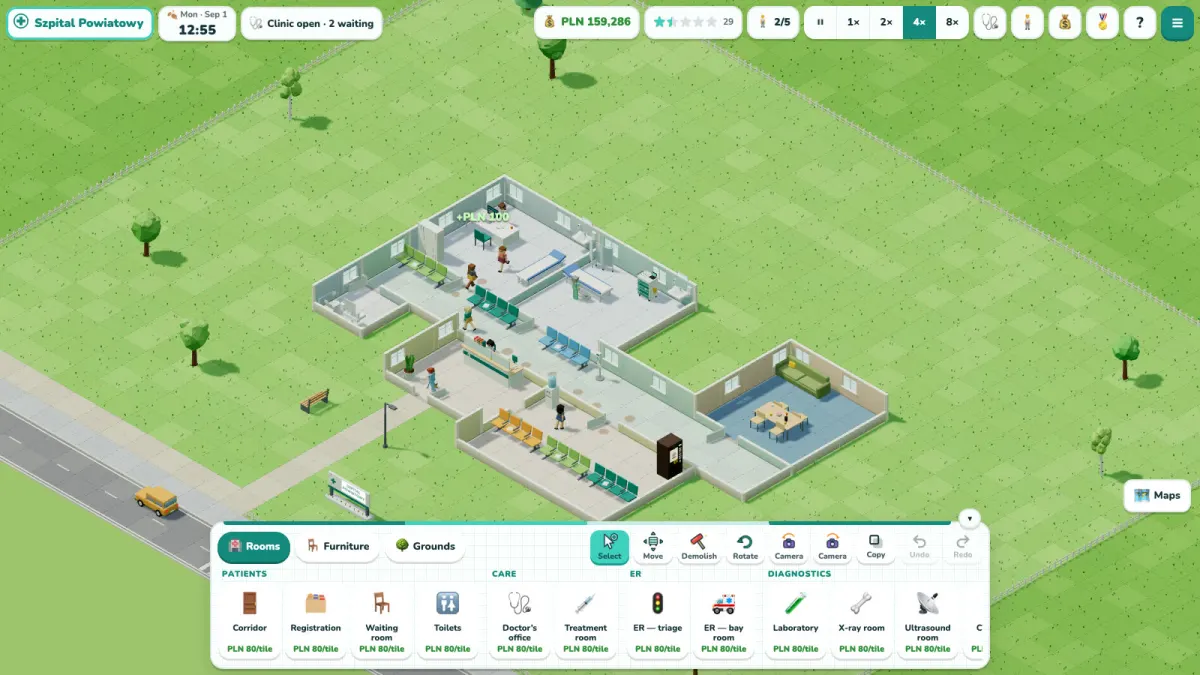
The screenshot shows a small building. It has a registration desk, waiting areas with chairs, two offices and a staff room for the workers. At the top you see your money, reputation stars and the speed buttons.
Your first minutes
- Click ⏸ at the top if you want to think in peace. The game stops and you can build.
- In the bar at the bottom, click the Rooms tab. It has groups: Patients, Treatment, ER and Diagnostics.
- Look at what is already built. Click a room and a small window tells you what it is missing.
- Start the game with 1×. 2×, 4× and 8× are faster.
- Look at the director's task card in the corner. It guides you step by step.
Patients arrive on weekdays from 7:30. First they sign in at registration. Then they wait for a doctor.
The most important number is waiting time. A patient who waits too long goes home. Then your reputation, the good name of your hospital, drops. The stars at the top show it.
Money at the start
NFZ pays for treatment. It is the health fund that pays the hospital for visits, tests and stays. You do not sell anything. You just treat people.
Good first moves are:
- a second doctor's office and a second doctor,
- then a laboratory and X-ray,
- last, an ER and a ward.
Controls
- Space pauses the game. Keys 1–4 change the speed.
- Q and E rotate the camera. R rotates the object you are placing.
- F opens finance, K staff, P patients and J quality and goals.
- Ctrl+Z undoes your last build.
- F1 opens the in-game Guide.
- On a phone, one finger pans and two fingers zoom. Tap two corners to build a room. ☰ opens the menu.
How it works
Building rooms
Pick a room in the build bar. Drag a rectangle on your plot. Walls appear by themselves. Then add doors and furniture.
- Each room has a minimum size. It also needs its own items, like a bed or a desk.
- If something is missing, click the room. The window tells you what to add.
- The Show furniture button in that window shows only matching items in the bar.
- Demolishing gives back half the price.
- Made a mistake? Click Undo. You have 30 seconds after building.
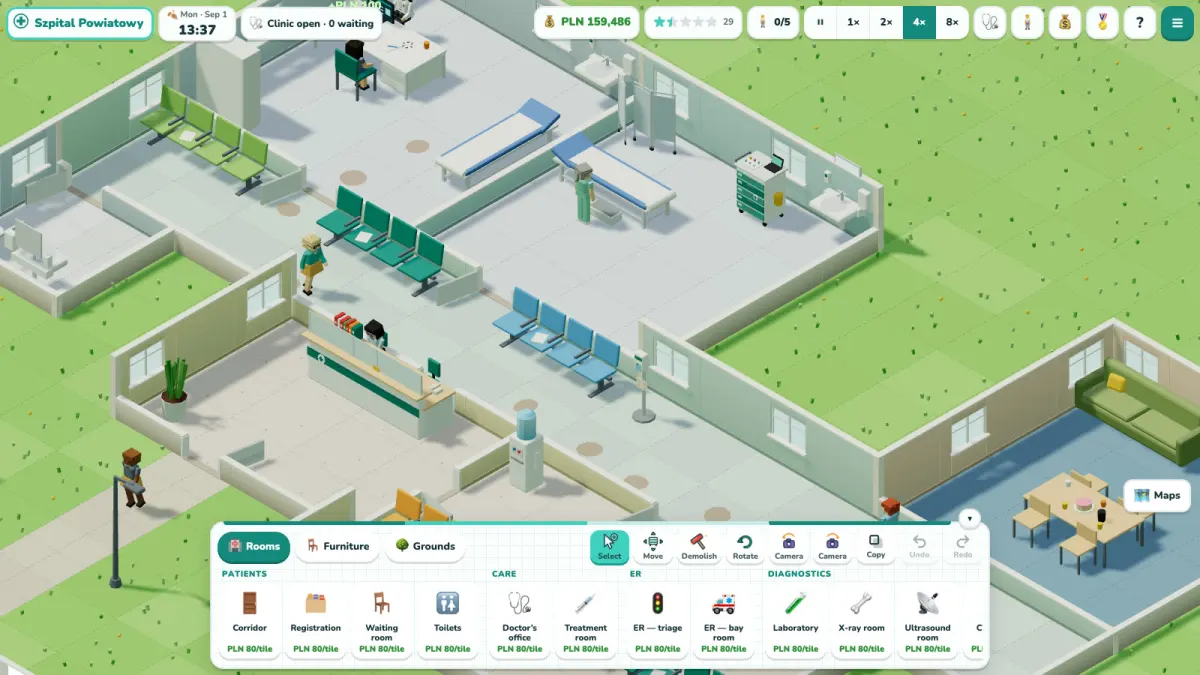
In the close-up you can see people sitting on benches. The doctor calls the next person, who waits on a bench outside the office. So put chairs next to office doors.
A patient's path in the clinic
A patient goes: registration, waiting room, doctor's office, sometimes tests, sometimes a treatment room, home.
- A receptionist runs one window. Electronic registration is twice as fast.
- A TV, plants and a water cooler in the waiting room make patients more patient.
- Someone who waits long goes to the toilet. With too few toilets, patients get in a bad mood.
- The clinic closes at 16:00. Whoever has not been seen goes home.
The ER, or emergency room
The ER runs around the clock. It needs two rooms:
- ER — triage: a nurse's desk and chairs,
- ER — bay room: beds or gurneys, a monitor and a defibrillator.
Triage means a quick check of who needs help first. The nurse gives each patient a colour:
- red means help at once,
- orange within 10 minutes,
- yellow within an hour,
- green within two hours,
- blue within four hours.
The colour floats above the patient's head. The doctor sees the more urgent colours first, not the people who came first. If someone waits longer than their limit, reputation drops.
Some patients come by ambulance. It stops on the road by the ER entrance and a paramedic wheels the patient in. If there is no free bay, the paramedic waits.
Ambulances and the helicopter
You can build a helipad on your plot. Then the most serious patients, red and orange, may arrive by helicopter. A paramedic takes them to the ER entrance. Put the helipad close to the ER so the way is short.
Tests
A doctor can send a patient for a test. You can choose:
- a laboratory for blood,
- X-ray for bones and lungs,
- ultrasound for the tummy,
- a CT scanner for the head,
- an MRI scanner for the knee and spine. It is the most expensive, but pays the best.
Technicians run the tests. Each test makes it more certain that the doctor picks the right treatment. If there is no room for it, the test is skipped. That is faster, but less safe.
Ward, ICU and maternity
People admitted to the hospital stay on a ward room for a few days. Nurses check on them. The ward doctor does rounds and sends them home.
- The ICU is for the most seriously ill. It has a bed, a monitor and a ventilator. NFZ pays the most for it.
- Maternity has a delivery room and a maternity ward. A midwife is a nurse from the Maternity department.
- If there is no free bed, the patient goes to another hospital. That hurts your reputation.
The operating theatre
An operating room needs a table, a lamp, an anaesthesia machine and an instrument table. It also needs a team: two doctors from the Theatre department and a nurse. After surgery the patient goes to a recovery room, then to a ward. An operation is the biggest single payment from NFZ.
Staff and the duty roster
Click Staff. There you hire people and set when they work.
- The morning shift runs from 7 to 15.
- The afternoon shift runs from 15 to 23 and costs 10% more.
- The night shift runs from 23 to 7 and costs 25% more.
- People can work Monday to Friday, or 5 days out of 7, weekends included.
The staffing table shows how many people work on each shift. Red cells are gaps. The ER, wards and ICU run around the clock, so they need three shifts. Tired people work slower. A staff room helps them rest.
Good tips
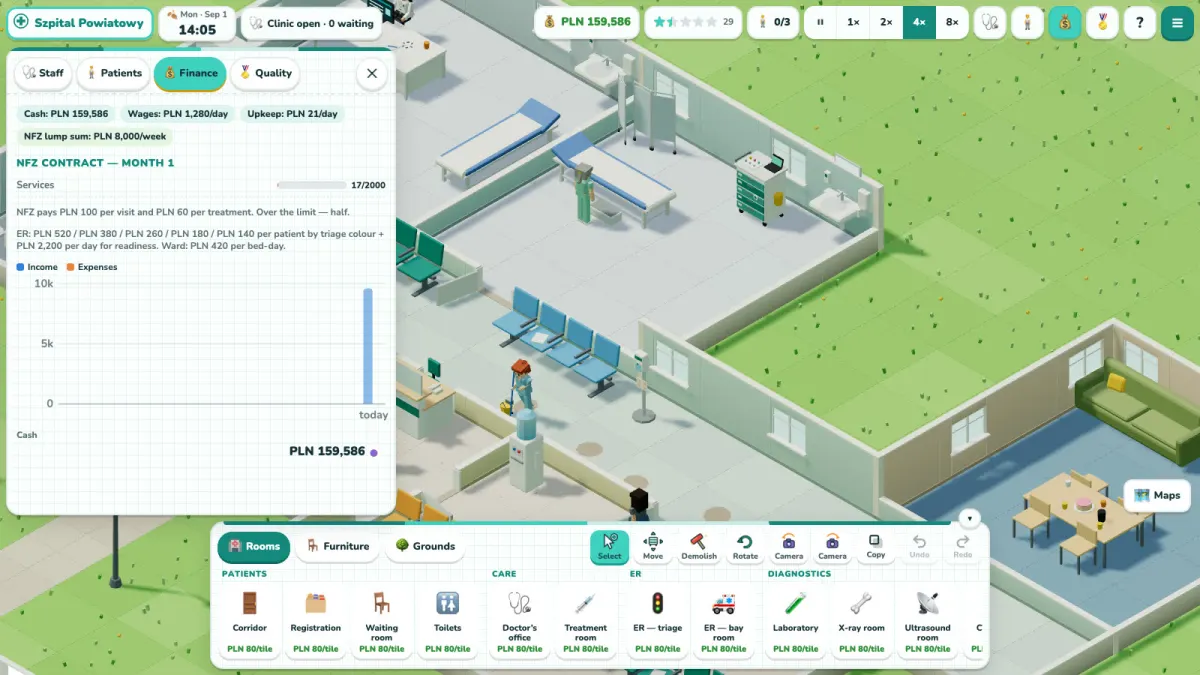
Open the Finance panel (key F, or the amount at the top). The screenshot shows the NFZ contract in the first month. There is a services bar, for example 18 out of 2000.
The contract limit
NFZ pays in full only up to the monthly limit. A month in the game has 28 days. For anything over the limit you get only half. A clinic visit pays PLN 100 and a treatment PLN 60. When the limit is near, do not build more offices. Improve quality instead.
Drugs and the pharmacy
Drugs and supplies cost about 12% of what NFZ pays. This is settled at midnight. A hospital pharmacy cuts that cost by 30%. It needs two pharmacy shelves and a sink.
Loan and staffing agency
In the Finance panel you can take a loan: PLN 50,000, 150,000 or 300,000. You repay it in instalments over 56 days. The interest is 12% in total. If you repay early, you pay no more interest.
In the Staff panel there is a staffing agency. It sends a doctor or a nurse for one shift. You pay upfront. It is a good fix for a gap in the roster, but it costs a lot.
Events
Every few days something happens. The game sometimes pauses by itself so you can decide.
- An NFZ audit. Filing cabinets lower the fines.
- A health inspection checks cleanliness, hand sanitisers and toilets.
- A power cut. A generator protects the ICU and theatre.
- Late oxygen. Oxygen tanks help, best at least two.
- Heat, snowstorm and flu. In a snowstorm some people cannot get to work.
- A mass casualty incident. An accident with many hurt people. A wave of ambulances arrives within an hour and a half.
Tips for pros
Quality and accreditation
Open the Quality panel (the 🏅 button or key J). It shows indicators from the last 7 days: waiting time, patients giving up, cleanliness, sanitisers, generator, staff room and toilets.
- An accreditation audit costs PLN 15,000. Auditors arrive after 3 days.
- A score of 75 out of 100 earns accreditation for 90 days.
- With accreditation NFZ pays 5% more and your reputation grows.
- If the audit fails, you can retry after 10 days.
Grants
Every week or two the county or the EU offers money for a specific build. It might be a CT scanner, a helipad or a generator. Click Accept in the Quality panel. You get a 25% advance at once. If you build what is asked in time, the rest of the money arrives. If you are late, the advance is returned and reputation dips slightly.
Doctor promotions
Doctors have ranks: resident, specialist, head of department. A higher rank means better work and a higher salary. A resident learns faster when a specialist is on duty in the same department. When the experience bar is full, a Promote button appears in the Staff panel. You pay for exams and courses. There can be only one head of department per department.
The alarm in a mass casualty incident
When an accident with many hurt people happens, you can raise the alarm. Then off-duty ER, theatre and ICU staff come in for 6 hours. You pay them overtime. Without the alarm, only the current shift copes.
Maps
The Maps button by the build bar shows traffic, waiting, dirt and infection risk. You can see where the hospital gets stuck. You can also copy a layout: select a rectangle with rooms and paste it on empty spots of your plot.
Campaign
The campaign has 8 scenarios. Each one has a ready-made hospital, money, a day limit and goals. Meet all the goals and you get 1 star. Two more stars are for harder tasks. Scenarios open one after another. You see the goals in the Quality panel.
- Clinic (14 days). See 195 visits and reach reputation of at least 50.
- Hospital in debt (42 days). You start with a PLN 40,000 debt. Get into the black and keep reputation at 35 or more.
- Flu season (21 days). See 130 ER patients. No more than 30% may wait too long.
- Maternity (28 days). Deliver 20 babies and reach reputation of at least 55.
- Theatre and ICU (35 days). Do 20 operations and collect 10 ICU bed-days.
- Summer by the lake (28 days). Receive 6 helicopter patients and 200 in the ER.
- Accreditation (42 days). Earn the accreditation certificate.
- Trauma centre (30 days). Build a helipad, do 25 operations and get through three mass casualty incidents.
Outside the campaign there are:
- New game with no deadlines,
- Sandbox with lots of money, a high NFZ limit and no bankruptcy,
- Daily challenge. Every day there is a new short scenario, the same for everyone. The game remembers your best score and your streak of days.
Watch out
- Too much building, too few people. An ER with nobody working in it earns nothing. Doctors first, new rooms later.
- No toilets or chairs. Tired patients are in a bad mood and leave.
- One shift in the ER. The ER runs around the clock. Set three shifts, or nobody will be there at night.
- Going over the NFZ limit. For extra work you get half the money.
- Debt. After 14 days in the red the county takes over the hospital and the game ends. Except in the sandbox.
Questions and answers
Do I need to know medicine?
No. Illnesses and treatment are very simplified in the game. It is play, not a medical lesson, and it has no medical advice. You only watch the queues, the people and the money.
What should I build first?
Start with a second doctor's office and a second doctor. Then build a laboratory and X-ray. Build the ER and a ward last, once you have money for the people.
Why do patients leave without treatment?
Most often they waited too long. Add an office, a doctor or chairs. Check the toilets too. The Patients panel (key P) shows you the patients and their mood.
How does the triage colour work in the ER?
The nurse gives a colour from red to blue. Red waits the shortest, blue the longest. The doctor sees the more urgent colours first, not the people who came first.
What happens when I run out of money?
First slow down building and check the roster. You can take a loan in the Finance panel. After 14 days in the red the county takes over. Then you can start again or play the sandbox, where there is no bankruptcy.
Can I play on a phone?
Yes. The game has touch controls. You can also add it to your phone's home screen and open it like an app.
Is my progress saved?
Yes. The game saves in your browser, in several save slots. You do not need an account.
How do I take a nice photo of my hospital?
Press Z or choose Photo mode in the ☰ menu. Set the frame, the time of day and a filter. Then click the round camera button.