Getting started
You begin at “Linden Stables”. You have three horses, a barn with three stalls, a tack room, a paddock and an arena. A groom and an instructor already work for you. The groom feeds the horses and cleans the stalls. The instructor teaches children to ride.
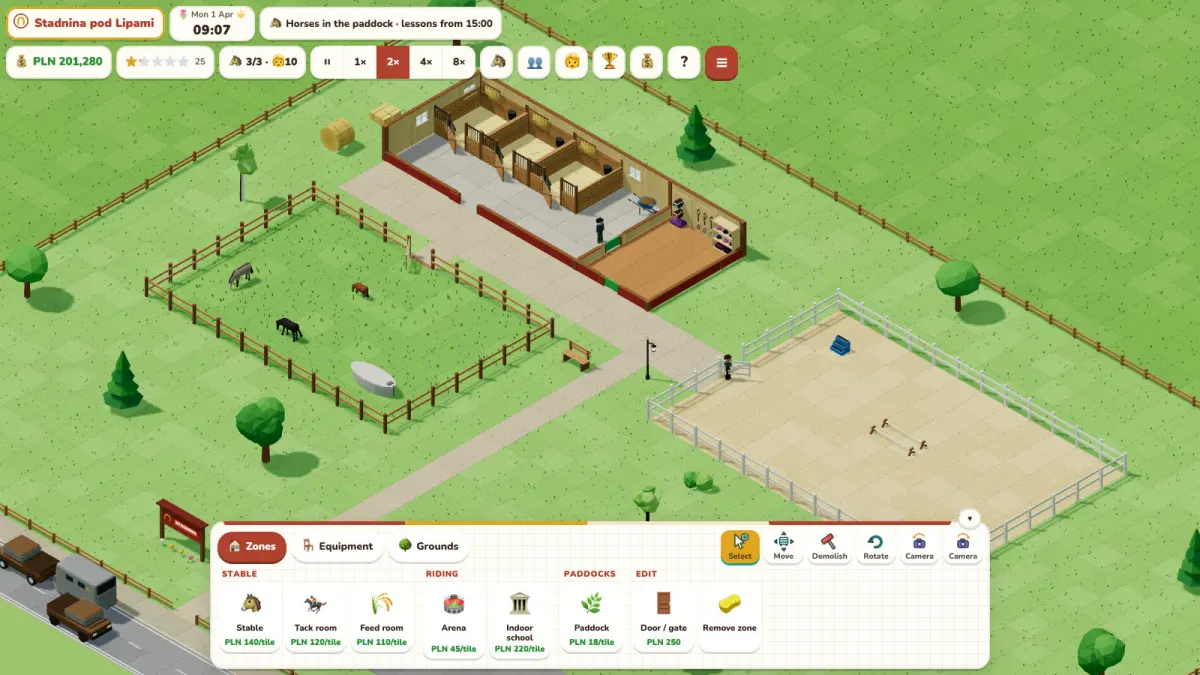
What you see on the screen
- At the top you see the name of your stables, the date and time, and the weather.
- Next to them are your money, your reputation stars, and the number of horses and pupils.
- Then come the speed buttons: pause, 1×, 2×, 4× and 8×.
- After that come the panel icons: Horses, Staff, Pupils, Shows and Finances.
- At the bottom is the build bar. It has three tabs: Zones, Equipment and Grounds.
Reputation is the good name of your stables. It grows when horses and children are happy and the stables look nice. The higher it is, the more children want to ride with you.
Controls
- On a phone: one finger pans, two fingers zoom and turn. To build a zone, tap one corner and then the other. The ☰ button opens the menu.
- The space bar pauses the game.
- The left mouse button pans the view. The right button turns the camera. The wheel zooms.
- The Q and E keys also turn the camera. R turns the object you are placing.
- F1 opens the guide inside the game. Esc closes a window or opens the menu.
The first minutes
- Set the speed to 2× and watch the first lesson. You will see how a pupil gets a horse.
- Open the Horses panel. Check that every horse has a stall.
- Buy a fourth horse and build another stall if you are short of room.
- Put a hay rack and a water trough in the barn. The horses will then have food and water.
- Look at the task cards in the corner of the screen. They lead you step by step.
Don't worry if something goes wrong. You can always stop the game with the space bar and think calmly.
How it works
Building zones
Pick a zone on the bottom bar and drag a rectangle on the grass. A stable costs PLN 140 per tile. An arena costs PLN 45 and a paddock PLN 18 per tile.
- Buildings (stable, tack room, feed room, indoor school) get walls. An indoor school is a big roofed arena.
- Outdoor areas (arena, paddock) get a fence.
- Add a door to a building and a gate to an outdoor area. Use the “Door / gate” tool and click a wall or a fence.
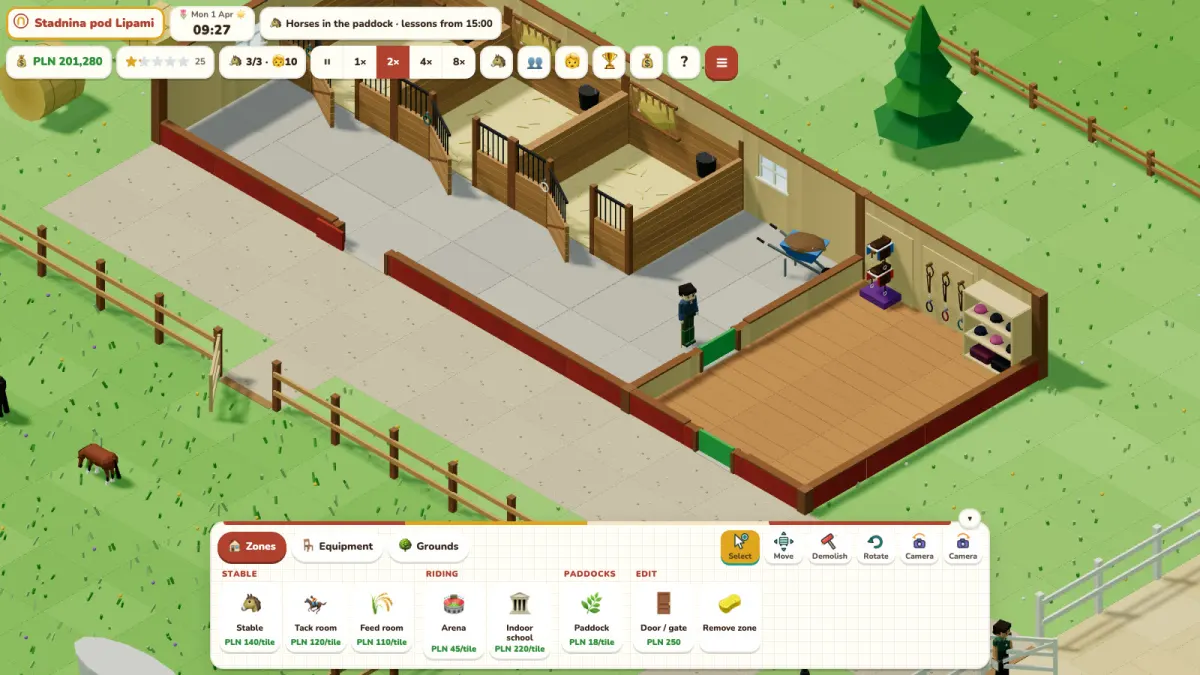
- Every zone needs equipment. A stable wants a stall, a tack room wants a saddle rack, a feed room wants a feed bin and a paddock wants a water trough.
- Click a zone. A little window shows what is still missing.
- The “Demolish” tool gives back half the price.
Horses and their care
Every horse has needs: food, water, a clean stall, exercise and rest. The groom feeds the horses three times a day. He also takes them to the paddock and cleans the stalls.
- The paddock gives horses exercise and a good mood. Each horse needs several tiles.
- The farrier looks after the hooves. Hooves wear down over time, so call him before things get bad.
- The vet treats sick horses. After that the horse rests for a few days.
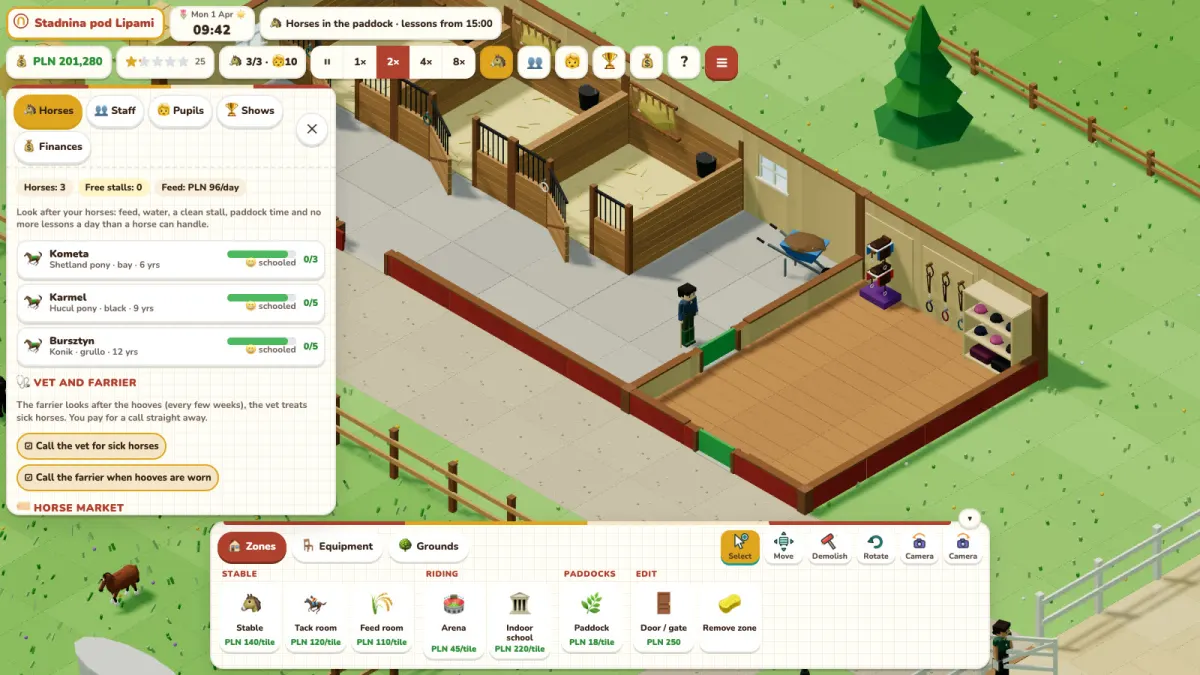
- In the Horses panel you can switch on automatic calls for the farrier and the vet. This is very handy.
- Each breed has a daily limit of lessons. A tired horse is sad and gets ill. Keep an eye on that limit.
In this game horses never die. The game is simplified, and this guide only explains its rules.
Pupils and lessons
Children sign up by themselves when you have free hours and a good reputation. A pupil comes to the arena, gets a horse and rides with the instructor. There are up to four people in a group.
- A pass is eight lessons. A happy child buys the next pass.
- Children learn step by step: first time on a horse, lunge, walk and trot, canter, jumping, shows.
- A lunge is a long line. The horse walks in a circle on it and the instructor stands in the middle.
- Cantering needs a trained horse. Jumping needs fences in the arena.
- The Pupils panel has a timetable. It shows which hours are busy.
- Falls are rare and gentle. Helmets and body protectors are a must.
Money
The Finances panel shows what you earn and what you spend. You earn from passes, lessons, trail rides, shows and camps. You spend on wages, feed, upkeep of zones, and the farrier and vet.
- If your cash stays below zero for too many days in a row, the bank takes over the stables.
- In the Finances panel you can take a loan: PLN 30,000, 80,000 or 150,000. You pay it back little by little over 56 days.
- Every few weeks a grant may arrive. You get part of the money at once and the rest when you meet the condition.
Good tips
What to build first
- Add a hay rack and a water trough to the barn.
- Build a second paddock so the grass does not vanish.
- Lay a gravel path. People and horses walk faster on it.
- Build a parking area for the parents' cars.
- Only then buy more horses.
Weather
The game starts on 1 April. In rain, storms and snow the arena is closed. Lessons move to the indoor school. Without one they are cancelled.
A cancelled lesson is not lost. It comes back as a make-up lesson in the first free slot. In storms and snow the horses stay in their stalls. In the heat they tire faster, so a field shelter with shade helps in the paddock.
Staff
In the Staff panel you hire new people. The list of candidates changes every week.
- A groom looks after the horses. With several horses a second one helps.
- An instructor runs lessons. Each instructor adds another group in the same hour.
- A receptionist sits in the reception and takes sign-ups.
- Workers get tired. Give them days off and build a staff room so they can rest.
- Watch your cover. With no instructor, a lesson is cancelled.
Tips for pros
Horse fair, breeder and auction
You buy horses in the Horses panel. The list changes every week.
- The horse fair is cheaper, but some horses have a hidden flaw. It can be a weak hoof or a sensitive back.
- The breeder sells young horses. You have to train them with lessons, and a trained horse is worth more.
- A pre-purchase vet check costs PLN 150. It shows whether a horse has a flaw.
- The sport horse auction takes place every two weeks on Saturday. You enter the most you want to pay.
- A flaw is not dangerous. That horse just needs the farrier or the vet more often.
Breeding and retirement
A healthy mare between 4 and 16 years old can have a foal. Pregnancy lasts 30 days. When the foal grows up, a trainer teaches it to carry a rider. This takes 14 days. Only then can the horse work with children.
An older horse, 15 or more, can retire. It stays at the stables and no longer works. Children love visiting it, so reputation grows.
Livery and hippotherapy
- Livery: a stranger leaves a horse with you and pays for the stall every day.
- Hippotherapy is a calm ride that helps children. The contract with a charity opens at reputation 40. You need a very calm horse.
Upgrades
Select an object and click the button with the price. Quartz on the arena makes lessons possible even in the rain. Body protectors and a CCTV camera keep everyone safer.
Your own shows
You host shows at the weekend in the Shows panel. There are three kinds: a children's gymkhana, “mini” jumping and class L jumping. A gymkhana is a fun show with skill games.
- The bigger the show, the more you need. You need fences, a judges' box and a grandstand.
- You set the entry fee and the ticket price.
- A storm or snow cancels a show.
- Every month there is a regional ranking. First place gives a prize and reputation.
- For shows away from home you need a trailer for two horses.
- You can build a dressage court or a cross-country course with fences in the open.
- A guest stable and a warm-up ring are needed for class L shows.
Camps and events
- Summer camp: in summer children come for morning lessons from Monday to Friday. Parents pay in advance.
- Trail rides for adults are switched on in the Pupils panel.
- The Hubertus ride is in autumn and the sleigh ride in winter, when there is snow.
The competition
From the second week, “Golden Mane” stables run across the village. Children choose stables by reputation and price. The rival takes some of your pupils.
In the Pupils panel you set your price list: promotion, standard or premium. Premium works from reputation 50. When you have saved a lot of money, you can buy out “Golden Mane”.
Campaign
You will find the Campaign in the main menu. It has eight scenarios. Each has goals and a time limit. For meeting all the goals you get the first star. The next two stars are for extra tasks. Every scenario you win unlocks the next.
- Three horses and a barn (21 days): give 20 lessons and own 4 horses. Stars: reputation 45 and PLN 55,000 in cash.
- Riding school (42 days): get 50 pupils on passes. At most 3 days with an overworked horse. Stars: 400 lessons and reputation 60.
- Summer in the saddle (42 days): run one camp and four trail rides. Stars: 100 pupils and PLN 120,000.
- First show (35 days): host a show and reach reputation 50. Stars: two shows and PLN 100,000.
- Golden Mane (56 days): win 55 percent of the market and get 100 pupils. Stars: reputation 60 and buying out the rival.
- Horse fair (56 days): earn PLN 8,000 from selling horses. Stars: no horse with a flaw and 8 horses.
- Regional cup (70 days): host a class L show, win 3 medals and have 4 guest stalls. Stars: reputation 70 and 20 hippotherapy sessions.
- Best stables in the region (120 days): reach 1st place in the ranking and buy out the rival. Stars: 150 pupils and reputation 75.
The sandbox is a game without deadlines and with lots of money. Before you start you choose whether the rival is on and whether hay is expensive.
In free play you pick a difficulty: Easy, Normal or Hard. You can also set horse illness, costs, the rival and rain separately.
Watch out
- Overworked horses. Keep to the lesson limit. A tired horse loses health and mood.
- Missing equipment. A zone with no stall, trough or rack does not work as it should.
- Too few paddocks. Worn-down grass is no good to anyone.
- No instructor in lesson hours. The lesson is cancelled and the children are sad.
- Neglected hooves and illness. Switch on automatic calls for the farrier and the vet.
- Buying horses without a check. You may buy a horse with a hidden flaw.
- Spending all your money. Keep some for wages and feed.
- Forgotten doors and gates. Without them a building has no entrance.
If you make a mistake, don't worry. Fix it and keep playing.
Questions and answers
Do horses die in the game?
No. Horses never die, at any difficulty. A sick horse goes to the vet and rests for a few days. A sold horse goes to a new, good home.
What should I build first?
Start with a hay rack and a water trough in the barn. Then add a stall and buy a fourth horse. Only after that expand the rest. The tasks in the corner of the screen help you choose the next steps.
Why was a lesson cancelled?
Most often because of rain, a storm or snow. Sometimes there is no instructor, arena or free horse. Such a lesson is not lost. It returns as a make-up lesson. An indoor school lets you teach even in the rain.
How do I get more pupils?
Look after your reputation. Care for your horses, build nice things and keep free hours in the timetable. Hire a receptionist. Happy children buy more passes.
Where do I get money when I am short?
Check the Finances panel to see what you spend on. You can take a loan or accept a grant. Good ways to earn are more lessons, trail rides and shows. You can also sell a horse you do not need.
Can I play on a phone?
Yes. The game runs in your phone's browser. Add it to your home screen and it opens full screen like an app. Your saves stay.
What does buying out “Golden Mane” do?
It ends the competition. All new children then come to you. You need a lot of money to buy it out. It is a goal in two campaign scenarios.
Is the game a real guide to horse care?
No. Horse care and riding lessons are simplified in the game. These are game rules, not advice on how to look after real animals.