Getting started
In the game you are the head teacher of a primary school. The council gives you an old, small school. You build it, furnish it and run it for a whole school year.
At the start you have 2 classrooms, 3 classes (45 children in total) and 3 teachers. There are more classes than rooms. So you need to build a new classroom soon. Don't worry, that is normal. We will do it in a minute.
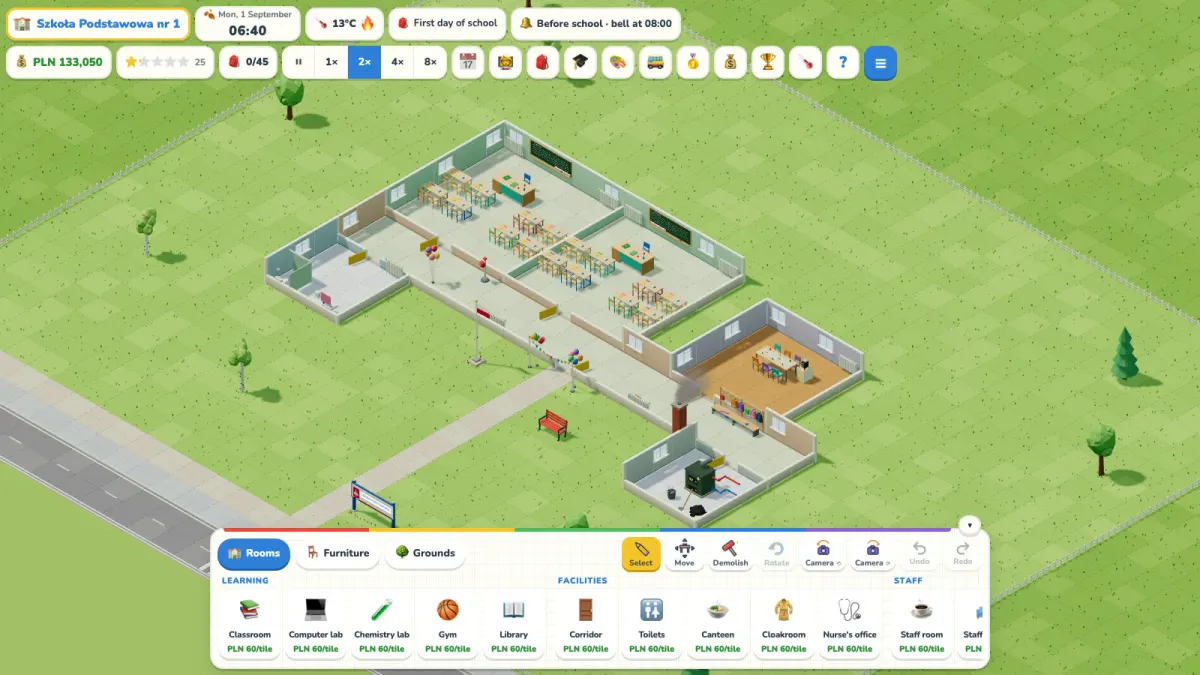
What you see on the screen
At the top there is a bar with the important things:
- the school name (you can change it by clicking),
- the date and time, and the weather,
- your money,
- a star with a number: this is your reputation, which means how well people think of the school (from 0 to 100),
- the number of children at school,
- the pause and speed buttons (1×, 2×, 4×, 8×).
Next to them are small icons for panels: timetable, staff, pupils, results, trips, contests, clubs and achievements. At the bottom is the build bar. It has three tabs: Rooms, Furniture and Grounds.
Controls
On a computer:
- The left mouse button selects and places things. You build a room by dragging a rectangle.
- Drag with the right button to turn the view.
- The mouse wheel zooms in and out.
- Space stops and starts time.
On a phone or tablet:
- One finger moves the view.
- Two fingers zoom, move and turn the view.
- You build a room like this: tap the first corner, then the second corner.
The first minutes: six steps
- Pause time (space, or the pause button). You can build in peace, the lessons will wait.
- Click a room to see whether it works and what it is missing.
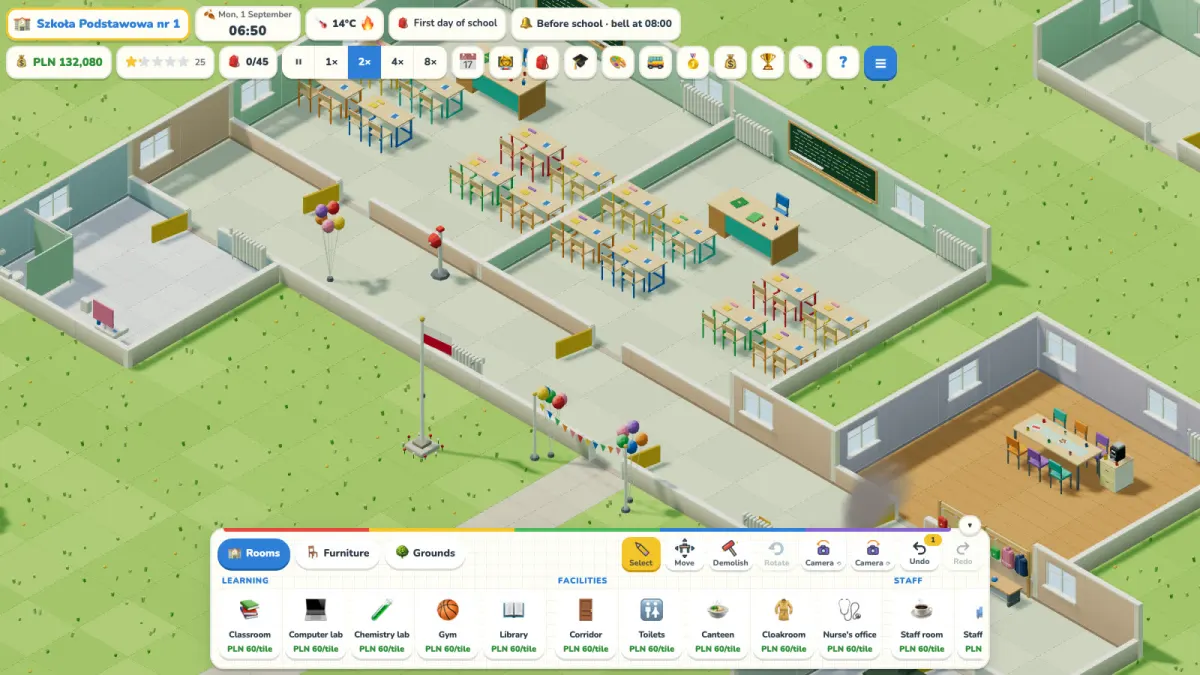
- Build a new classroom next to the corridor. Choose Classroom and mark a rectangle. It needs at least 12 tiles. Each tile costs PLN 60. The door appears by itself.
- Put a board, a teacher's desk and 4 desks in the room. Each desk seats 2 children.
- Open the timetable (key P) and see what is missing.
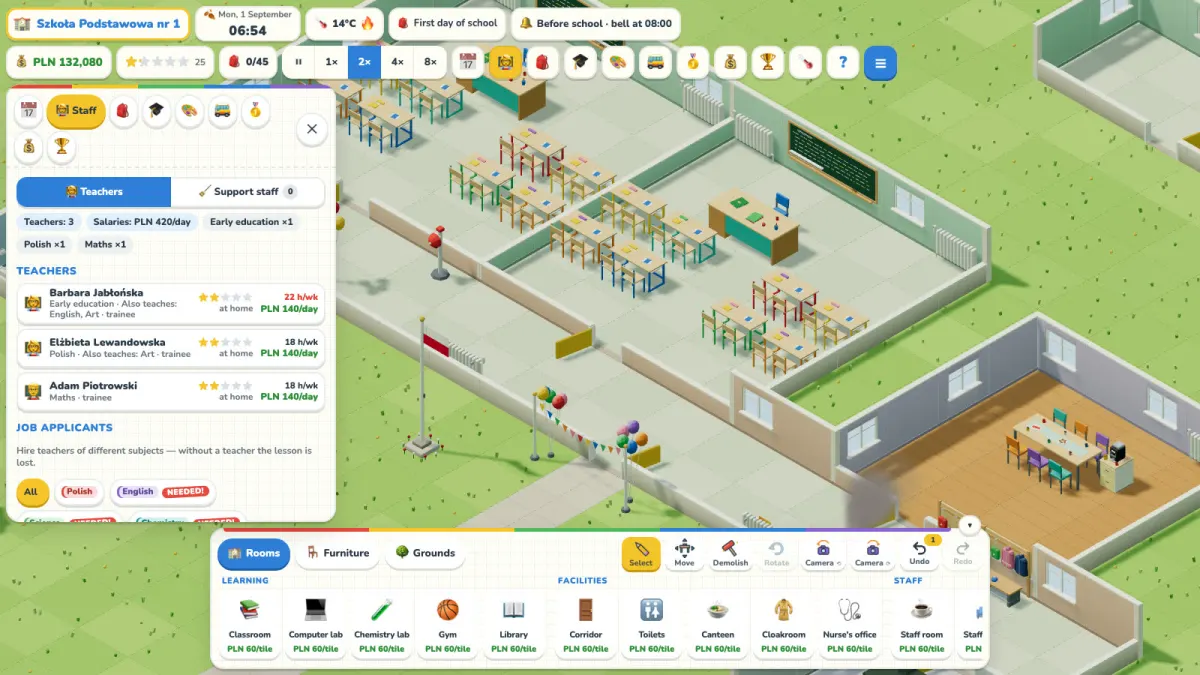
- Hire the missing teachers in the Staff panel (key K). Then let time run. The first bell rings at 8:00.
The most important things
Rooms and doors
The school is made of rooms. Walls appear by themselves. A room works when it has three things:
- enough space,
- all the equipment it needs,
- at least one door.
Doors appear by themselves and cost PLN 250. If you don't like where one is, use the Door tool and add your own. Click a room and you will see what it is missing.
Examples of how much space a room needs:
- classroom: 12 tiles,
- toilets: 4 tiles,
- nurse's office and boiler room: 6 tiles,
- canteen: 16 tiles,
- gym: 30 tiles.
Made a mistake? The Undo button takes back your last build. Demolishing things gives half the price back.
The timetable
The timetable is the heart of the school. It says who teaches what, where and when. It builds itself. When you change a room or a teacher, the timetable changes too. The Build timetable button makes it again from the start.
Under the timetable there is a list of problems. Read it, because it tells you simply what to do:
- missing teacher: hire someone who teaches that subject,
- no room: build a room or a lab,
- overloaded teacher: they have too many hours,
- missing hours: a class has too few lessons.
When there is no teacher or no room, the lesson is missed. The children learn less and feel sadder. So keep the timetable full.
Teachers
You hire them in the Staff panel. Each teacher teaches one subject. For every applicant you see the subject, rank, skill (1 to 5 stars) and daily wage. Hiring costs PLN 600, and the teacher arrives the next morning.
You pay wages every day, also on weekends and in the holidays. A teacher gives about 18 lesson hours a week. If someone has more than 22 hours, the timetable will not give them more.
Teachers get tired. A tired teacher teaches worse. They rest in the staff room, and faster in the staff lounge. If a teacher is very tired for several days, they go on sick leave or ask for a raise.
Money
- Every Monday morning the council pays PLN 290 for each pupil. This is your main income.
- Every night you pay wages, bills and equipment upkeep.
- You pay at once for building, buying things and hiring.
Open the Finances panel with key F, or click the money at the top. It shows where the money goes.
A day at school
A lesson lasts 45 game minutes. The first bell is at 8:00. After the third lesson there is a long break for lunch. Years 1–3 have 4 lessons a day, and older classes have more. There are no lessons on weekends and in the holidays.
Good tips
- Rooms first, then teachers. A teacher without a room cannot teach.
- Build rooms next to the corridor. The children then walk a short way.
- At the start buy chalkboards (PLN 400). A projector costs PLN 1,800 and a smartboard PLN 4,200. They are better, but expensive.
- Build more toilets. After a break the children queue up. One toilet is enough for about 30 children.
- Hire a cleaner (PLN 95 a day) and a caretaker (PLN 110 a day). The caretaker fixes broken things. The cleaner clears the litter.
- Do you want the children to eat lunch? Build a canteen (16 tiles) and hire a cook. Without a cook the kitchen does not cook.
- Look at the problem list in the timetable. It is the best hint you get.
- In the holidays, before the new year starts, build ahead. Then you disturb nobody.
- Children need somewhere to sit. A child without a desk place learns twice as slowly.
Tips for pros
Labs
Some lessons need special rooms:
- Computing: a computer lab, or an ordinary room with a tablet cart.
- Chemistry in Years 7 and 8: a chemistry lab.
- PE: a gym or a sports court.
Science and English work in an ordinary classroom. In their own lab the children learn better, though. A lab needs as many places as there are pupils in the class.
Teacher promotions
Teachers have ranks: trainee, appointed and chartered. A higher rank means better lessons, but a bigger wage. When a teacher is ready, they ask for a promotion themselves. Then send them on a training day. After that a committee decides whether they get the promotion.
Heating
In winter you must heat. You need a boiler in the boiler room and radiators in the rooms. One radiator is enough for 20 tiles. The coal boiler has the smallest power and the most expensive heating. You can upgrade it to a gas boiler, and then to a heat pump. The heat pump heats most cheaply.
In a cold room children learn worse. A comfortable warmth starts at about 19 degrees.
The Year 8 exam
In May the pupils of Year 8 write an exam in Polish, maths and English. The result goes into the district ranking. A good place raises your reputation, and then more children sign up for the school. Give Years 7 and 8 your best teachers and all the hours of those subjects.
Trips, contests and clubs
- You plan trips in the Trips panel (key T). You pick the class, the place and the date. Parents pay part of the tickets.
- Contests are, for example, olympiads, the maths Kangaroo and sports games. You send your best pupils, and cups raise your reputation.
- Clubs (key Z) meet after lessons. There are chess, robotics, sports, art, theatre, English and gardening. Children are happier, and parents pay a small fee.
- The garden: beds, a greenhouse and a compost bin. The caretaker waters them. In June you collect a harvest for the canteen.
The school inspection
Once a year, in the second half of the year, an inspector arrives. They check the rooms, the timetable, heating, cleanliness, toilets, the canteen, the nurse's office, the school office and the cameras. They give 0 to 100 points. With 90 points or more you get PLN 5,000. Under 50 you pay a fine of PLN 4,000.
Campaign
The campaign has 11 scenarios. Each has a ready-made school, a deadline and goals. For reaching the goals you earn stars (up to three). A won scenario unlocks the next one. You can see the goals in the Goals panel (key G).
- Village school: a small school with a tiny budget. Last until the end of the year with a good reputation.
- After the flood: July, the water is gone. You repair the school before 1 September.
- Reform: you need new labs and a full timetable.
- Winter of the century: frost and debt. Keep the rooms warm.
- Ranking: get into the district top 3 after the exam.
- The big inspection: in four weeks an inspector comes. You need at least 70 points.
- School merger: twice as many classes arrive.
- Dream school: a big school and a long game. You unlock it after winning 5 scenarios.
- Cycling school: build a sports court and bike racks so the children can pass the cycling licence.
- Green school: start a garden and a gardening club.
- School of the future: equip three new labs and compete in the robotics contest.
The campaign is good practice. Each scenario teaches a different part of running a school. If you lose, simply play it again.
Watch out
- Too few rooms. New children arrive on 1 September. Before the holidays end, add rooms and desks.
- Too little money. If you are in the red on 14 of 21 days, the council closes the school. Being in the red for a short while is fine. Wait for Monday's subsidy and don't buy new things.
- Cold. In winter check the boiler and radiators before the snow comes.
- A room without a door. A room without a door does not work.
- Not enough desks. Few desks mean weaker learning.
- Tired teachers. Don't give them too many hours, and build a staff room.
- Dirt. Without a cleaner the school gets dirty, and the children are unhappy.
- A building mistake. Use the Undo button or the Demolish tool.
FAQ
Why doesn't my room work?
Click it. The game shows what is missing. Most often it is a board, a teacher's desk, desks or a door. It also helps to check that the room has at least 12 tiles.
Where does my money come from?
Mostly from the subsidy. The council pays PLN 290 for each pupil every Monday. You also earn from lunches, clubs, contests and the garden harvest. More children means more money, but also more rooms and teachers.
What is reputation?
It is how well people think of the school, from 0 to 100. You see it next to the star at the top. It grows when the children learn well and are happy. The higher it is, the more children want to join.
What happens when a lesson is missed?
The children learn less and feel worse. Look at the timetable. Most often a teacher or a room is missing. Fill the gap and everything gets back to normal.
How do I save the game?
The game saves by itself at the end of every day. You can also save by hand in the menu (the button with three lines). You have 6 slots for saves. You can also export a save to a file.
Which mode should I pick first?
For a first try, the Campaign and its first scenario, Village school, are good. It has a ready-made school and clear goals. Sandbox gives you PLN 120,000 and never closes the school for debt. In a Normal game you start with PLN 35,000.
Can I change the difficulty?
Yes. In the New game window you pick Easy, Normal or Hard. Easy gives more money at the start. Hard gives less money and more mischief at school.
How do I play on a phone?
Add the game to your home screen and it opens full screen. You build a room by tapping two corners. The round button with an arrow turns the thing you are placing. You move the view with one finger.